

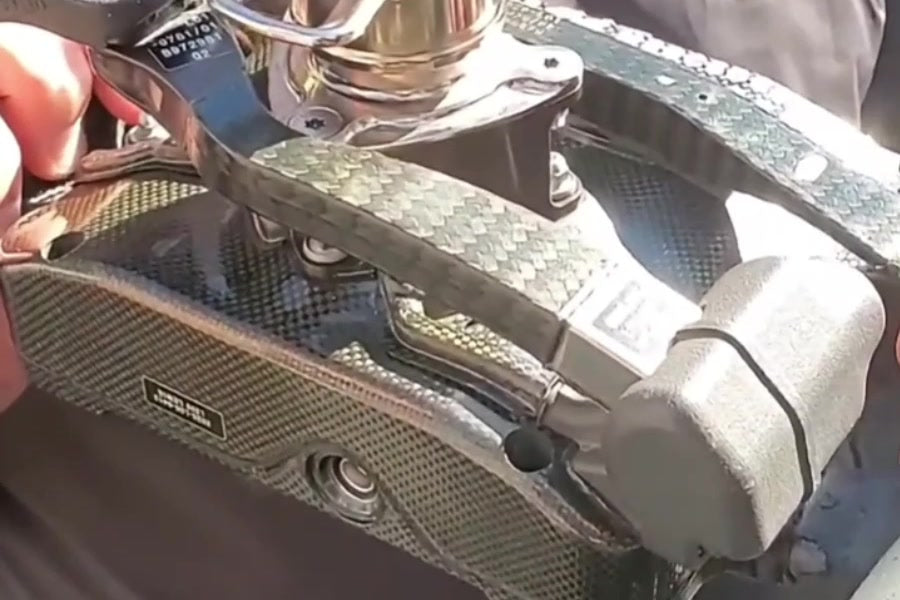
A Formula 1 steering wheel is designed around the driver, right down to the shape of a paddle and the position of a finger. This short, fan-recorded clip gives us a close look at Lewis Hamilton’s Mercedes-era wheel — and two details that deserve a closer look: the way he protects against an accidental downshift at the start, and the use of 3D printed components.
Why put a hand over the top of the wheel?
It can look as though Hamilton is covering a secret control. The engineer’s explanation is much simpler: his finger physically blocks the downshift side of the gear-change rocker on the back of the wheel.
The rocker operates in two directions: one for an upshift and the other for a downshift. As the driver launches and releases a control, an unintended movement of that rocker could trigger a downshift. Placing a finger against the relevant side prevents that movement at a moment when the driver needs to concentrate on getting the car away cleanly.
The clutch and the gear-change rocker have different jobs. The clutch controls the launch; the gear-change mechanism selects the next gear. The hand position shown here is a safeguard against an accidental shift, rather than a hidden setting on the front of the wheel.
3D printed parts, on a real F1 wheel
For us, the other revealing moment comes near the beginning. The engineer describes the component around the top of the wheel as carbon-filled SLS — selective laser sintering, a form of additive manufacturing commonly called 3D printing.
That matters because a printed component can be a deliberate engineering choice. A wheel needs shapes that fit a driver’s hands, position controls precisely and package mechanisms into very little space. Additive manufacturing gives designers another way to produce those shapes and refine them without committing every change to a new mould.
Mercedes also explains how it uses rapid prototyping in its own introduction to 3D printing in F1. The clip brings that subject down to something you can actually see and touch: a part of the driver’s steering wheel.
Why this matters to our RSR and CORE wheels
At MVH Studios, we use 3D printing to manufacture parts for our RSR and CORE Series wheels. It helps us produce purpose-built shapes, develop our designs and build in the smaller quantities that make sense for our UK workshop.
The connection is the manufacturing principle: choosing a process that suits the part and its job. SLS is one form of 3D printing. Different parts call for different processes and materials; the shared idea is using additive manufacturing where it makes engineering sense. The clip shows that printed parts have a place in serious steering-wheel engineering.
Alongside the printed parts, the RSR brings together magnetic Hall-effect shifters, configurable controls and an optional dual-clutch system. It is our own wheel, designed for sim racing and built around the way you want to race.